
Is Yuma, AZ a Good Place to Live? An Honest Local Look at the Pros, Costs, and Trade-Offs
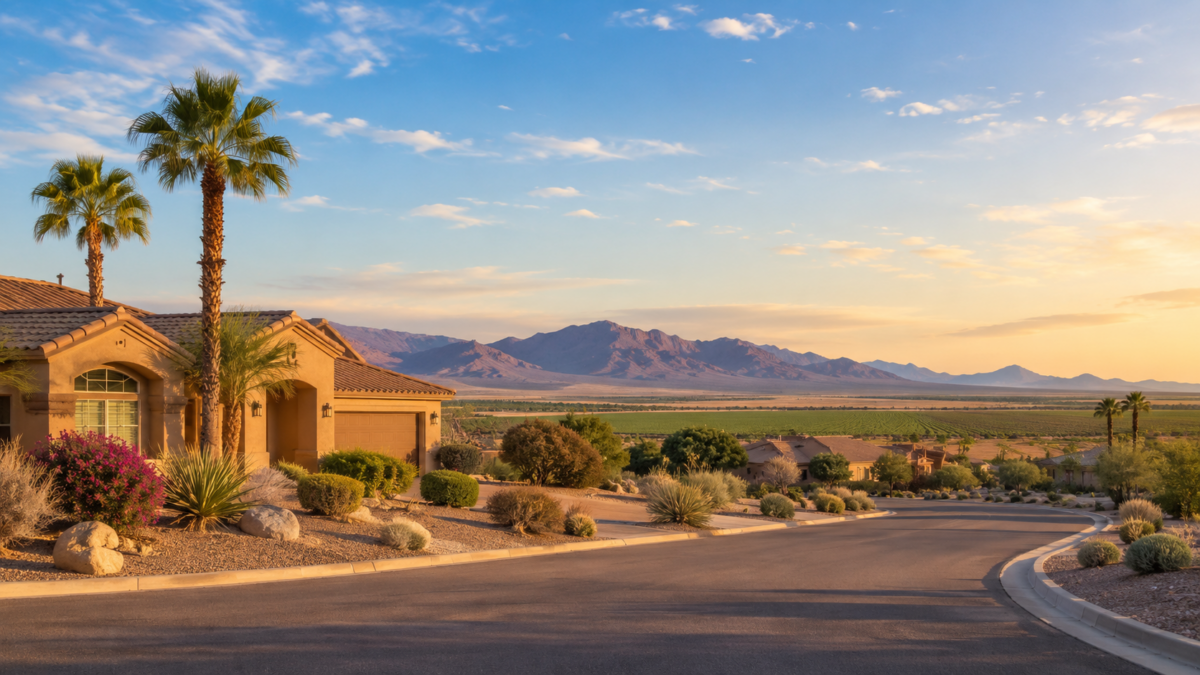
Yes, Yuma in Arizona is a suitable place to live if what you care about is affordability, sunshine, a slower way of life, and easy access to military bases, agricultural jobs, and the Colorado River; it is one of the most affordable metropolitan areas in Arizona and one of the sunniest places on the planet. That said, there are real drawbacks: very hot summers with triple-digit temperatures, a limited job market focused on only a few industries, seasonal population fluctuations due to winter visitors, and a smaller range of big-city facilities compared to Phoenix or Tucson. If you place a higher value on low housing costs and mild winters rather than on nightlife and a variety of career opportunities, then Yuma is probably a good choice for you.
Key Takeaways
- The main reason people are attracted to Yuma is its affordability, since housing there is typically much cheaper than in Phoenix or Tucson.
- Winters are exceptional, while summers frequently exceed 110°F, affecting daily life from June to September.
- The economy is based upon four sectors: agriculture, the military (at MCAS Yuma and Yuma Proving Ground), healthcare, and trade across the border with San Luis Río Colorado.
- Retirees and snowbirds are thriving in the area, driving a large seasonal rental and RV market.
- Ideal for: military families, retirees, people working from a distance, and those who are looking to save money.
- The most difficult aspect is that it affects heat-sensitive residents and those specialized professionals who need a deep job market.
- If Yuma isn’t suitable for you in the long term, you do have some options, such as a simple cash sale, which would involve omitting repairs and showings.
Where in Arizona is Yuma, and who actually resides there?
Yuma is located in southwestern Arizona, at the point where the Colorado and Gila rivers converge. It borders California to the west and Mexico to the south, and is about a three-hour drive from both Phoenix and San Diego. The fact that it is situated there is the one feature that is least appreciated about living in the area: you enjoy the cost structure of a small city together with easy weekend access to a large beach city.
The city’s year-round population is about 100,000, and Yuma County’s total is roughly 200,000. However, the most important figure is the seasonal one: every winter, tens of thousands of ‘snowbirds’ come from colder states in the United States and from Canada, occupying the RV parks, restaurants, and church car parks from November through March. The residents take this into account when making their plans. The traffic on 4th Avenue in January is quite unlike that in July.
How is the culture of the community?
Yuma is a family-oriented community with a strong bilingual presence, greatly influenced by two main factors: farming and the military. People here speak about the lettuce harvests and squadron deployments as if they are one and the same. It’s a town where neighbors keep an eye on whether your sprinklers are running at the wrong time and where high school sports events still draw a crowd.
Over the years, as people have sat at kitchen tables with residents of Yuma, a pattern has emerged: they seldom move to Yuma by chance. Instead, they go there for work, for a job, to join family, or in order to spend the winter, and a surprising number choose to remain.
What Are the Pros and Cons of Living in Yuma, AZ?
| Pros | Cons |
| Low cost of living, especially housing | Extreme summer heat (often 110°F+) |
| Exceptional sunshine and mild winters | Limited industry diversity and fewer high-wage roles |
| Strong military presence and veteran services | Higher-than-average seasonal unemployment tied to agriculture |
| Short commutes; little traffic most of the year | Winter-visitor crowding from November to March |
| Outdoor recreation: Colorado River, dunes, hiking, dark skies | Fewer major-league sports, concerts, and shopping options |
| Close to San Diego, Phoenix, Mexico, and Los Algodones | Long drive to a large international airport |
| Slower pace, tight-knit neighborhoods | Less rental inventory for long-term tenants in peak season |
What is the cost of living in Yuma, AZ?
Yuma is regularly one of the more affordable places in Arizona to live, primarily because of its low housing costs; home prices have historically been much lower than in Phoenix and Tucson and considerably lower than in nearby California markets. The only exception is utilities; newcomers most tend to underestimate the cost of summer cooling bills.
How much should I allocate?
| Expense category | What to expect in Yuma | Planning tip |
| Housing | Generally below the Arizona statewide average | Get insurance and tax quotes before you make an offer |
| Electricity / cooling | Highest costs June–September | Ask sellers for 12 months of utility history |
| Water & irrigation | Varies by lot size and landscaping | Desert landscaping cuts costs significantly |
| Groceries | Near national average; produce is often cheaper in season | Shop local growers in winter |
| Transportation | Car-dependent; short distances | Fuel costs stay low thanks to short commutes |
| Healthcare | Regional hospital plus VA services available | Confirm specialist availability before relocating |
The figures are subject to change; therefore, it is necessary to check the most up-to-date figures with the local utility companies, the Yuma County Assessor, and your insurance agent before preparing a budget.
What Is the Weather Really Like in Yuma?
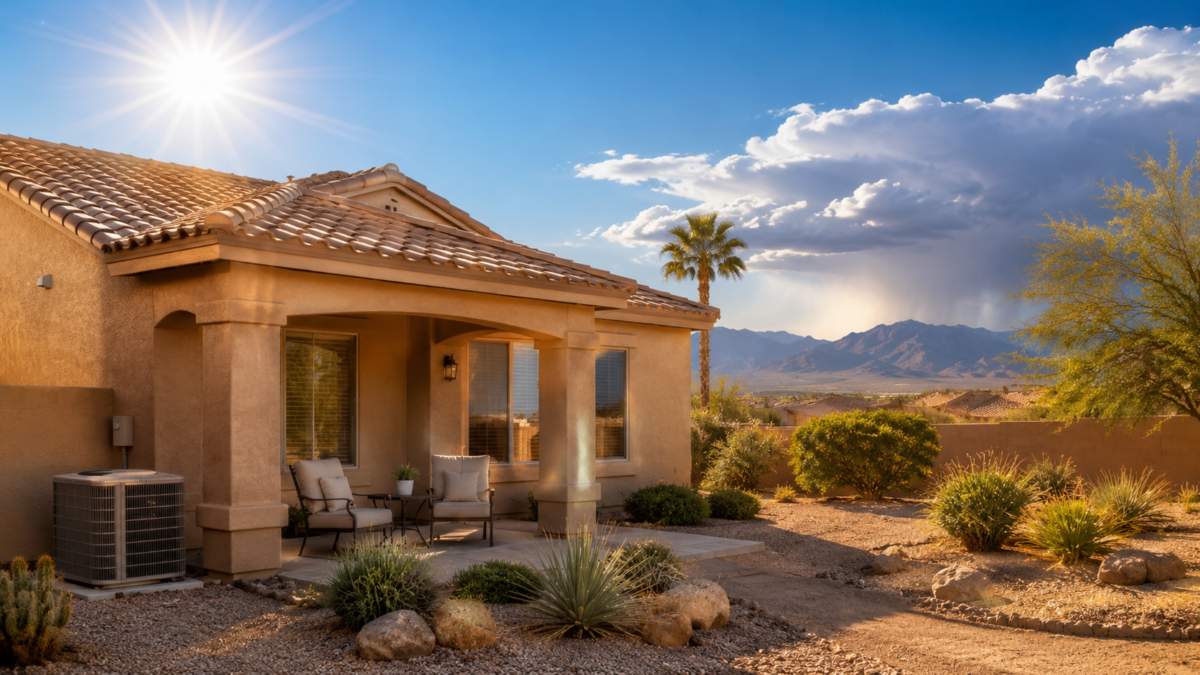
Yuma is internationally known as one of the sunniest places on Earth, with sunshine during the vast majority of daylight hours. It is uncommon for it to rain; the humidity is generally low, and the sky is usually a clear blue.
Here’s the honest version, month by month:
- From November through March: nearly perfect conditions, with warm days and cool nights, ideal for being on the patio—this is the reason snowbirds come.
- From April to May, the weather warmed rapidly, with windy periods, and it was still very pleasant in the early and late parts of the day.
- From June through August, it is intense; triple-digit temperatures are the norm, and people start getting up early to use the air conditioning.
- From September through October, the period cools, with some monsoon-season moisture and dramatic skies.
The fact is that few people talk about how the high temperatures affect both the construction and the upkeep of houses in this area. Air conditioning systems have to work harder, roofs wear out more quickly due to exposure to ultraviolet radiation, and the exterior paint fades. Whenever we look at houses in Yuma, the age of the air conditioner and the state of the roof are usually the two most important factors affecting value.
Is Yuma a good place to live for veterans and military families?
For many people, this is what makes Yuma stand out. Marine Corps Air Station Yuma and the U.S. Army’s Yuma Proving Ground are based in the area, and the community’s regard for service members is not superficial but built into the fabric of the community. There are a number of veteran-owned businesses, VA services are easy to access, and neighbors understand the cycles of deployment since they have experienced them themselves.
What ought military families to know before purchasing here?
- The timelines for PCS are seldom in line with those for real estate, and a conventional listing can take from weeks to months to close.
- Rents go up in the winter months, and people who move in during December have to compete with higher seasonal demand.
- If you plan to stay here for several years, the cost of buying might be worth it, but you should calculate the expenses associated with holding the position in case you are reassigned.
- The importance of having an exit strategy should not be underestimated. While some families intend to rent out the house, others prefer a quick and guaranteed sale. Deciding in advance which option you’ll take before you buy will prevent panic later on.
Should orders be received and a clean exit be required, our team specializes in helping service members sell their Yuma house quickly for cash, with the closing date matching the moving truck, not the market.
What are the best neighborhoods and areas in Yuma?
| Area | Best for | Character |
| Historic Downtown / Century Heights | Character-home lovers | Older homes, walkable core, ongoing revitalization |
| East Yuma / Mesa del Sol area | Families, newer construction | Newer subdivisions, schools, master-planned feel |
| Foothills (Fortuna Foothills) | Retirees and snowbirds | Larger lots, desert views, strong seasonal community |
| Yuma Mesa | Space and privacy seekers | Citrus groves, acreage, semi-rural feel |
| Somerton & San Luis | Agriculture workers, commuters to Mexico | Bilingual, close-knit, lower price points |
| Near MCAS Yuma | Active-duty families | Convenient commutes, rental demand |
It’s worth noting a local point: two houses that appear almost identical can have very different prices depending on the land’s orientation, the roof’s age, and whether the HVAC system has been replaced. In Yuma, a house’s condition is often more important than its exterior appearance.
What kinds of jobs and industries support Yuma’s economy?
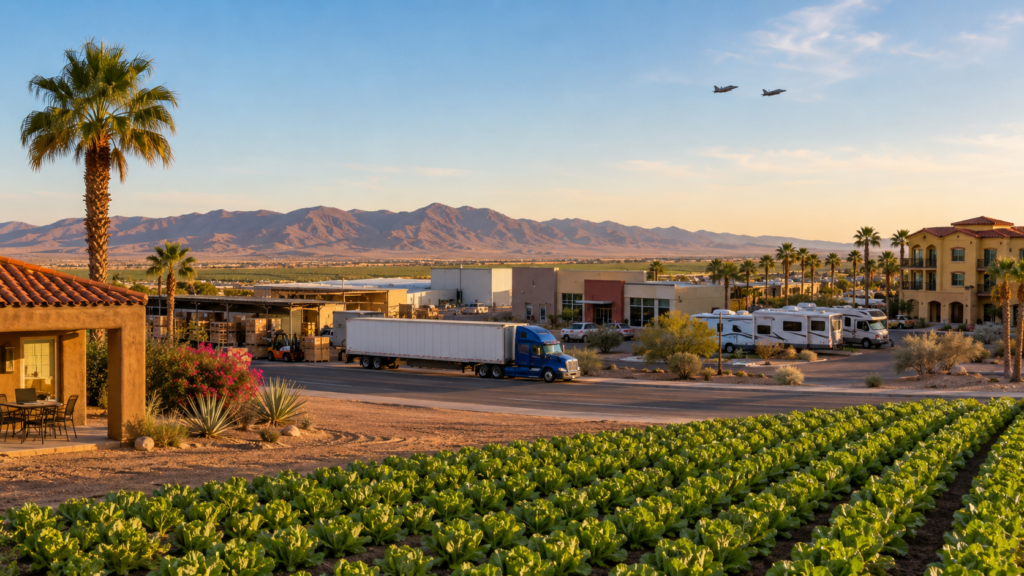
Yuma is a national agricultural powerhouse since the area provides a major portion of the leafy greens needed in the country during the winter months, and for this reason it is known as the “Winter Lettuce Capital of the World”. This results in a clear seasonal pattern in labor, with employment rising during the harvesting season and then decreasing during the hottest months.
- Agriculture and food processing — the region’s economic backbone
- Military and defense — MCAS Yuma, Yuma Proving Ground, and their contractors
- Healthcare — regional hospital systems, clinics, and elder care
- Retail, hospitality, and tourism — driven heavily by winter visitors
- Logistics and cross-border trade — freight moving through the San Luis port of entry
- Remote work — a quietly growing group taking advantage of low housing costs
For someone whose career depends on a dense professional network, such as in the fields of technology, finance, and biotechnology, Yuma will seem restrictive unless one works remotely. It is this one question that determines whether many new arrivals remain in the area long-term.
What activities are available in Yuma?
- Boating, kayaking, and fishing along the Colorado River and area lakes
- Off-roading at the Imperial Sand Dunes, a short drive west
- Historic sites including the Yuma Territorial Prison and Colorado River State Historic Park
- Winter farmers markets, food tours, and agritourism unique to the growing region
- Day trips to Los Algodones, Mexico, and weekend runs to San Diego or Phoenix
- Golf year-round, with peak conditions in winter
Who is Yuma suitable for and who should hesitate?
| Yuma is likely a great fit if you… | Yuma may frustrate you if you… |
| Want low housing costs and low property taxes relative to California | Need a large, diverse job market in your specific field |
| Love sunshine and hate snow | Struggle with extreme heat or high cooling bills |
| Are retiring, seasonal, or work remotely | Want walkable urban living, transit, and nightlife |
| Are military-connected or a veteran | Rely on frequent international air travel |
| Value quiet, community, and short commutes | Want extensive shopping, dining, and cultural variety |
What if I move to Yuma and it turns out to be the wrong choice?
People don’t admit it as often as it actually happens – it isn’t a failure. Orders do change. A job comes to an end. The second summer turns out to be longer than the first one. A property that was inherited in the Foothills becomes a burden when you’re 1,500 miles away.
You generally have three paths:
| Option | Typical timeline | Best when | Watch out for |
| List with an agent | Weeks to months | Home is updated, and you can wait | Repairs, showings, commissions, buyer financing falling through |
| Rent it out | Ongoing | You want long-term income and can manage from afar | Tenant turnover, maintenance, summer HVAC failures |
| Sell direct for cash | Often days to a few weeks | You need speed, certainty, or the home needs work | Choose a transparent buyer and compare the net, not just the price |
The mission of Yuma Home Buyers is to provide homeowners with a reliable, transparent way to sell their property quickly for cash. Since each situation is unique, we adjust the process—including the closing date — to meet your requirements rather than ours. If you want to see exactly how our cash home-buying process works, you can read the answers to frequently asked questions from sellers or learn more about our local team and mission.
What should we say to homeowners who ask us directly?
Three things, every time:
- You should look at the net price rather than the headline price; a headline price less repairs, commissions, holding costs, and two additional months’ worth of summer electric bills usually results in a cash offer that sellers do not anticipate.
- Have the condition properly evaluated. In Yuma, the condition of the roof and the HVAC system has a greater effect on value than the kitchen finishes.
- Select the timeline that will safeguard your peace. The value of certainty should not be underestimated, particularly during a PCS, a divorce, or a probate.
Frequently Asked Questions About Living in Yuma, AZ
Is Yuma, AZ safe?
Safety depends on the neighborhood, just as it does in other cities. While Yuma has some quiet residential areas, it also has certain areas where property crime is more common. Before selecting a neighborhood, it is advisable to review the most up-to-date local law enforcement statistics and visit the area at different times of day.
Is Yuma a good place to retire?
Yes, for many retirees, Arizona is attractive because of its mild winters, lower housing costs, golfing opportunities, a lively year-round social scene, and the fact that the state does not tax Social Security benefits. However, you should check to make sure that healthcare and access to specialists are available to meet your particular requirements and also seek advice from a tax professional regarding your individual case.
How hot does Yuma really get?
Summer temperatures often exceed 110°F, and at times they exceed 115°F. Although humidity is generally low outside the monsoon season, the heat is intense and should be taken into account when making your decision.
Is Yuma less expensive than either Phoenix or Tucson?
Yes, historically so—especially when it comes to housing. Wages are usually lower as well, so it’s necessary to compare the income you can expect with the local costs rather than just the prices.
How long does it take to sell a house in Yuma?
A traditional listing typically takes weeks to months depending on condition, price, and season. A direct cash sale can often close within a few days to a few weeks.
The Bottom Line: Is Yuma, AZ a Good Place to Live?
Yuma is a good place to live for the right person, someone who wants affordability, sunshine, community, and simplicity, and who can make peace with a hot summer and a smaller job market. It rewards people who slow down. It frustrates people who need constant options.
And if you’re already here and the fit has changed, that’s a solvable problem. Whether you list, rent, or sell direct, the goal is the same: a clear-eyed decision and a stress-free exit. If a fast, transparent cash sale sounds like the right path, reach out for a no-obligation cash offer on your Yuma home — no repairs, no showings, no pressure.
This article is general educational information about living in Yuma, Arizona, and is not legal, tax, or financial advice. Costs, market conditions, and local data change; verify current figures with official sources such as the U.S. Census Bureau, the National Weather Service, the Yuma County Assessor, and licensed professionals before making decisions.